Paul Bracq
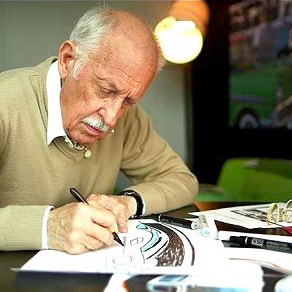
Paul Bracq (born 13 December 1933) is a French automotive designer and artist whose work has made a significant contribution to European automotive design in the second half of the 20th century. Born in Bordeaux, France, his distinguished career is closely associated with some of the world's most renowned automotive manufacturers, including Mercedes-Benz, BMW, and Peugeot.
Bracq began his professional career at the design studio of Philippe Charbonneaux, where he worked as an assistant between 1953 and 1954. Following his military service, he joined Daimler-Benz in Sindelfingen in 1957. Over the following decade, he contributed to the design of numerous models that have since become automotive icons, including the prestigious Mercedes-Benz 600, the 230 SL “Pagoda”, the 220 S Coupé, and the W108/109 and W114/115 series.
In 1967, Bracq returned to France and joined Brissonneau & Lotz, where he contributed to the interior design of the French TGV high-speed train. During this period, he also developed automotive concepts including a sports coupé based on the BMW 1600 Ti and a coupé based on the Simca 1100.
A defining chapter of his career began in 1970 when he became Design Director at BMW. His work helped establish the brand's distinctive design language of the 1970s and influenced the first generations of the BMW 3, 5, 6, and 7 Series. One of his most celebrated creations was the futuristic BMW Turbo of 1972, the company's first concept car. With its dramatic wedge-shaped profile, gullwing doors, and innovative safety features, the Turbo anticipated design elements that would later appear in BMW production cars, most notably the BMW M1.
In 1974, Bracq joined Peugeot, where he focused primarily on interior design and contributed to numerous models over the following decades. His career therefore encompasses an exceptionally broad spectrum of automotive and industrial design, ranging from luxury saloons and sports cars to experimental concept vehicles and public transport.
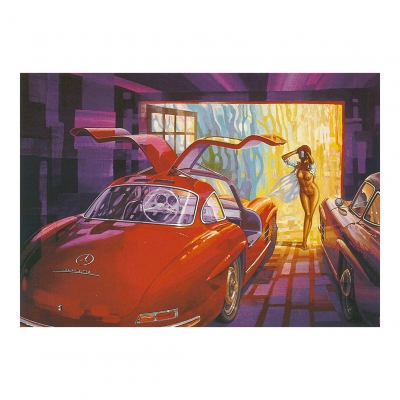
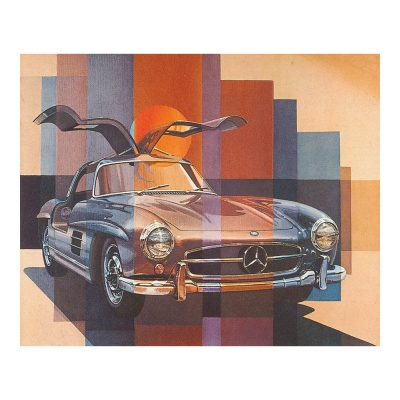
Alongside his career in automotive design, Paul Bracq has maintained a lifelong passion for fine art. His drawings and paintings reflect the same fascination with automobiles, proportion, movement, and elegance that characterises his design work. His artwork has also been exhibited in museums; in 1993, his paintings and sculptures were displayed alongside the BMW Turbo at the Kunsthaus Wiesbaden.
Paul Bracq is regarded as one of the influential figures of 20th-century European automotive design. In recognition of his contribution to automotive heritage, he was inducted into the FIVA Heritage Hall of Fame in 2024.